
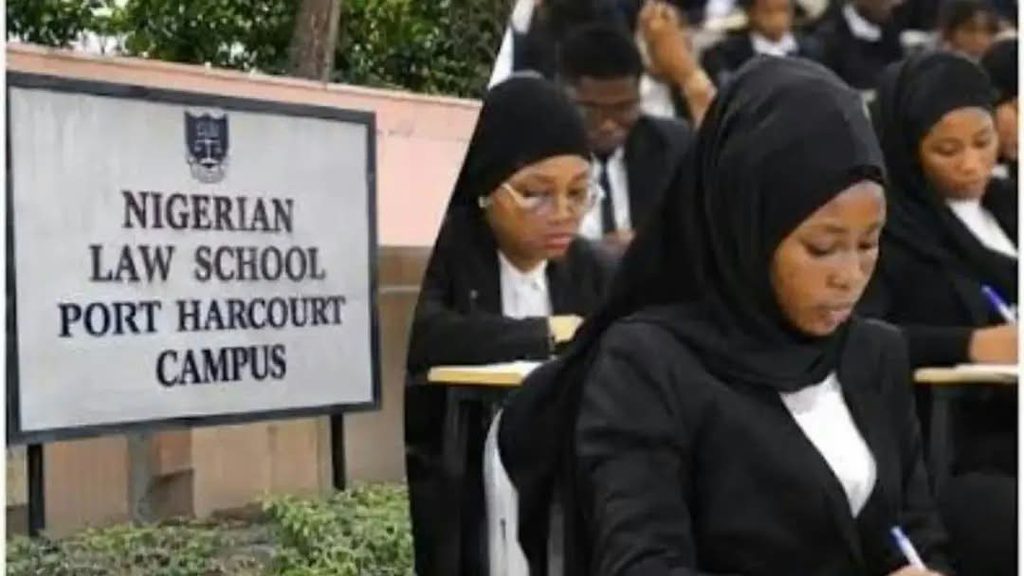
A fresh controversy has emerged at the Nigerian Law School following allegations that some Muslim female law graduates were delayed and denied access to examination halls during their final Bar examinations over their use of the hijab.The incident, reportedly recorded on Saturday, October 31, 2026, at the Port Harcourt campus, has triggered widespread reactions across social media, reigniting national conversations about religious freedom, discrimination, constitutional rights and institutional dress codes.
According to accounts circulating online, some candidates who arrived at the examination venue were allegedly instructed to remove their hijabs or adjust them into head coverings that exposed their ears and necks before being allowed into the examination halls.One of the affected candidates, whose experience was shared by an X user identified as @rahmandeprof, claimed that students had earlier been informed that shoulder-length hijabs were permitted under the institution’s existing dress code.
However, she alleged that a new directive from the Director-General of the Nigerian Law School prohibited the use of hijabs during the examinations.The candidate further claimed that some students were left waiting outside the examination halls for more than an hour and were warned that they could be denied entry to subsequent examination papers if they failed to comply.
Another X user, @AbuUbayy1, also alleged that some female candidates were instructed to adjust their long gowns and skirts alongside their hijabs.As of the time of this report, the Nigerian Law School had not issued an official public statement addressing the allegations.
RELIGIOUS FREEDOM AND THE DEBATE OVER DRESS CODES
The development has generated questions about the balance between institutional examination regulations and the constitutional rights of candidates to practise their religious beliefs.Several social media users have questioned the justification for restricting the hijab, particularly in the absence of publicly established evidence that the religious garment had been used to facilitate examination malpractice.
Human rights activist Moshood Ibrahim criticised the reported development, arguing that an institution responsible for training legal practitioners should uphold constitutional principles and respect existing judicial decisions.He also referenced the 2017 controversy involving Amasa Firdaus Abdulsalam, a law graduate whose refusal to remove her hijab during the call-to-bar ceremony generated nationwide debate.
MURIC DEMANDS SUSPENSION OF BAR EXAMINATIONS
The Muslim Rights Concern (MURIC) has called for the suspension of Bar examinations across Nigerian Law School campuses pending an investigation into the alleged treatment of Muslim female candidates.In a statement issued on Sunday, November 1, 2026, the organisation’s founder and Executive Director, Professor Ishaq Akintola, alleged that hijab-wearing candidates were prevented from entering examination halls in different locations across the country.
MURIC claimed that some candidates were made to wait outside examination venues for approximately an hour and were only permitted to enter after removing or adjusting their hijabs.The organisation described the reported incidents as an infringement on the candidates’ religious rights and an obstruction of their educational and professional advancement.It also warned that it could mobilise parents, Muslim youths and other stakeholders for peaceful protests across Nigerian Law School campuses if its demands were not addressed.
WHAT DOES THE NIGERIAN CONSTITUTION SAY?
The controversy has also drawn attention to provisions of the 1999 Constitution of the Federal Republic of Nigeria, particularly those relating to religious freedom, equality and human dignity.Section 38 guarantees freedom of thought, conscience and religion, including the right to manifest religious beliefs through worship, practice and observance.
Similarly, Section 42 prohibits discrimination on specified grounds, including religion, while Section 34 protects the dignity of the human person.MURIC maintains that the alleged restrictions violate these constitutional protections.
The organisation also referenced the Supreme Court’s 2022 judgment in Lagos State Government & Others v. Asiyat Abdulkareem, which addressed the right of Muslim female students to wear hijab in public schools in Lagos State.However, the specific application of existing judicial decisions to the Nigerian Law School’s examination regulations remains a matter requiring careful legal consideration.
REVISITING THE 2017 AMASA FIRDAUS CONTROVERSY
The latest development is reminiscent of the 2017 controversy involving Amasa Firdaus Abdulsalam, who was prevented from participating in her call-to-bar ceremony after insisting on wearing her hijab beneath her legal wig.The incident generated widespread public debate over religious identity, professional dress regulations and the rights of Muslim women in legal institutions.
In June 2018, the Body of Benchers approved her participation in the call-to-bar ceremony, and she was eventually called to the Nigerian Bar in July 2018 while wearing her hijab.Her experience subsequently became a significant reference point in discussions surrounding religious accommodation within Nigeria’s legal profession.
THE WAY FORWARD
The latest allegations have once again placed the Nigerian Law School under public scrutiny, raising important questions about institutional accountability, religious accommodation and the enforcement of examination regulations.While examination authorities have a responsibility to maintain security, discipline and the integrity of professional examinations, such measures must also be implemented transparently and consistently with applicable constitutional and legal protections.
The Nigerian Law School is yet to publicly clarify the circumstances surrounding the reported incident or explain the alleged change in its dress-code directives.As reactions continue to emerge, attention remains focused on whether the institution will investigate the complaints and provide clarity for affected candidates ahead of subsequent examination papers.


Leave a Reply